
Borrowing and Lending Is Now Live on Plug Wallet, Powered by Yusan
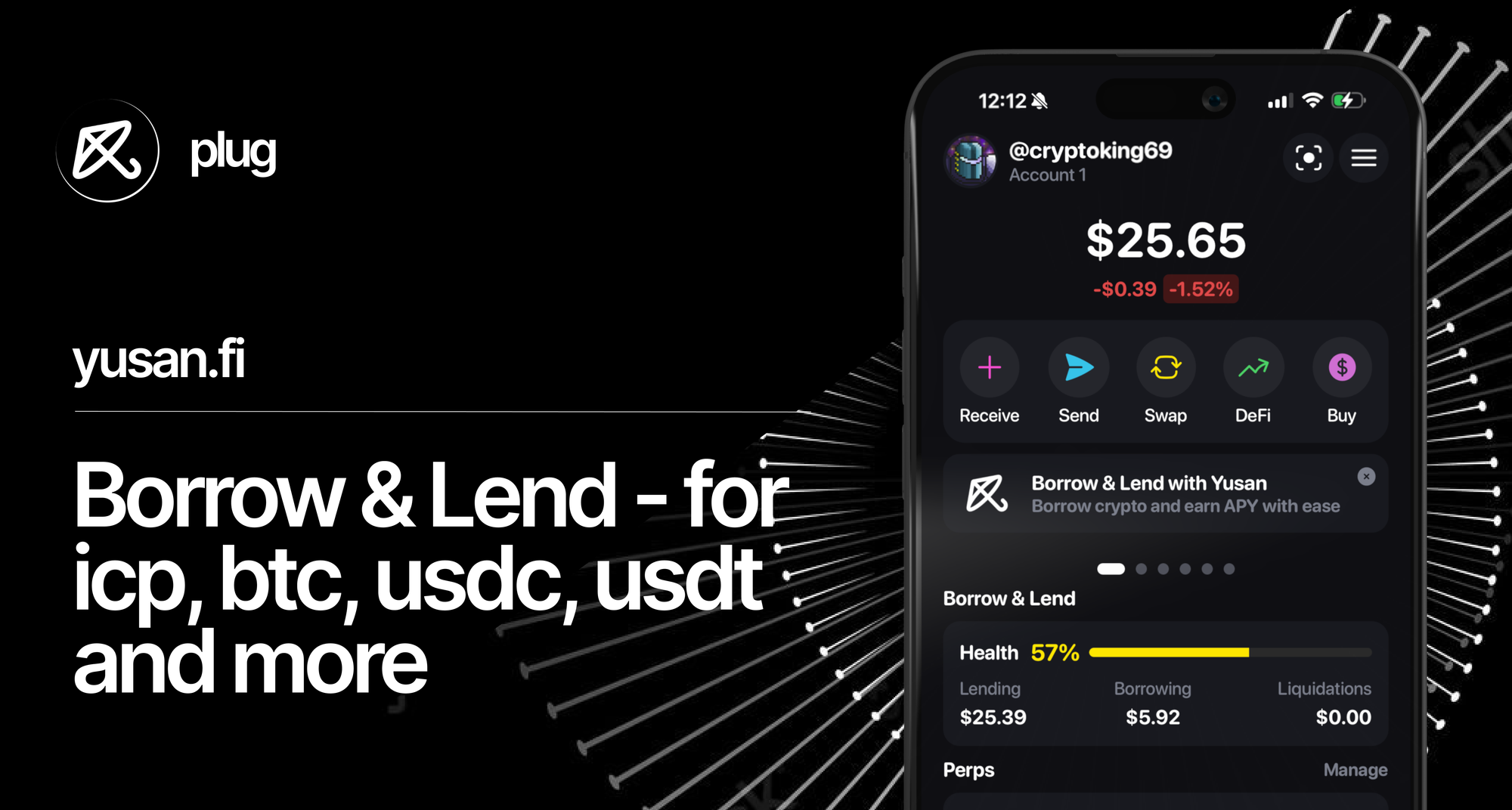
Borrowing and lending is one of the core primitives of DeFi. It allows users to supply assets to earn yield, or borrow assets against collateral without selling their holdings. With the integration of Yusan into Plug Wallet, this functionality is now available directly inside a non-custodial, cross-chain DeFi wallet, marking an important milestone for both Plug and the broader ICP ecosystem.
Plug users can now supply and borrow assets such as native BTC and native ICP directly from their wallet. This is significant. Native asset support means users are not interacting with wrapped tokens. They are using real BTC and real ICP, while remaining fully in control of their private keys.
In traditional DeFi environments, borrowing and lending often requires navigating complex interfaces, connecting multiple wallets, and managing transactions across different platforms. Plug simplifies this experience. Users can access borrowing and lending directly from their crypto wallet, alongside swaps, staking, leverage trading, and other DeFi tools. The result is a more unified and intuitive experience.
Borrowing and lending works by allowing users to deposit crypto as collateral and borrow another asset against it. For example, a user may supply BTC as collateral and borrow USDC without selling their BTC position. On the other side, users who supply assets to the protocol earn yield from borrowers who pay interest. This creates an on-chain lending market, fully transparent and managed by smart contracts.
Yusan introduces a unique innovation through its liquidation pool mechanism. In most DeFi lending protocols, when a borrower’s position becomes unhealthy, liquidators compete to close the position, often using automated bots to capture the liquidation bonus. Yusan takes a different approach. Users can deposit assets into a liquidation pool. When a position is liquidated, the pool automatically acquires the collateral at a discount. Participants effectively obtain crypto below market price, accelerating yield generation through discounted asset acquisition rather than relying solely on interest payments.
Inside Plug, interacting with this mechanism is straightforward. Users can supply assets, monitor positions, and participate in the liquidation pool without navigating advanced DeFi dashboards. The integration abstracts away much of the technical complexity typically associated with borrowing and lending protocols. For many users, this is the first time they can access sophisticated DeFi tools directly from a non-custodial wallet interface.
The launch of borrowing and lending strengthens the role of native BTC and native ICP within cross-chain DeFi. By enabling these assets to be used as productive collateral, Plug expands their utility beyond simple holding. Native BTC can now be used in decentralized lending protocols, while native ICP becomes more deeply integrated into a growing on-chain financial ecosystem.
Yusan is currently in alpha, and the integration within Plug represents a first version. Supply caps are in place and yields are conservative while the protocol matures. Over time, users can expect expanded limits, improved capital efficiency, enhanced monitoring features, and additional tools designed to improve risk management. Plug will also continue refining the user experience, including clearer position tracking and smarter notifications.
With borrowing and lending now live, Plug advances further as a complete non-custodial DeFi wallet. Combined with native asset support, cross-chain swaps, leverage trading, yield generation, and unified identity through Plugbook, the wallet continues to evolve into a core piece of cross-chain DeFi infrastructure.